

Climate and Nature
Climate
Climate change poses risks to the entire food supply chain and requires preparedness. The most significant risks posed by climate change for Apetit are related to the prevalence of various extreme weather phenomena, such as increased heavy rains and drought. These affect yield levels, raw material quality, availability and prices. Preparing for climate change may also affect the production costs of primary production.
In its Group-wide operating policy, Apetit is committed to reducing identified material climate and environmental impacts. Adaptation to climate change and emission reductions targeted across the entire value chain play a central role in Apetit’s strategy.
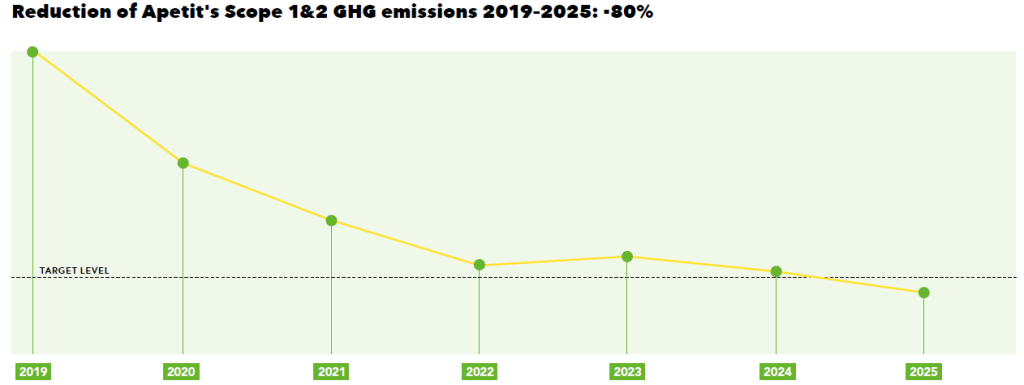
The greenhouse gas emissions of Apetit’s own operations are mainly caused by the energy used by production plants.
Reduction of climate impacts
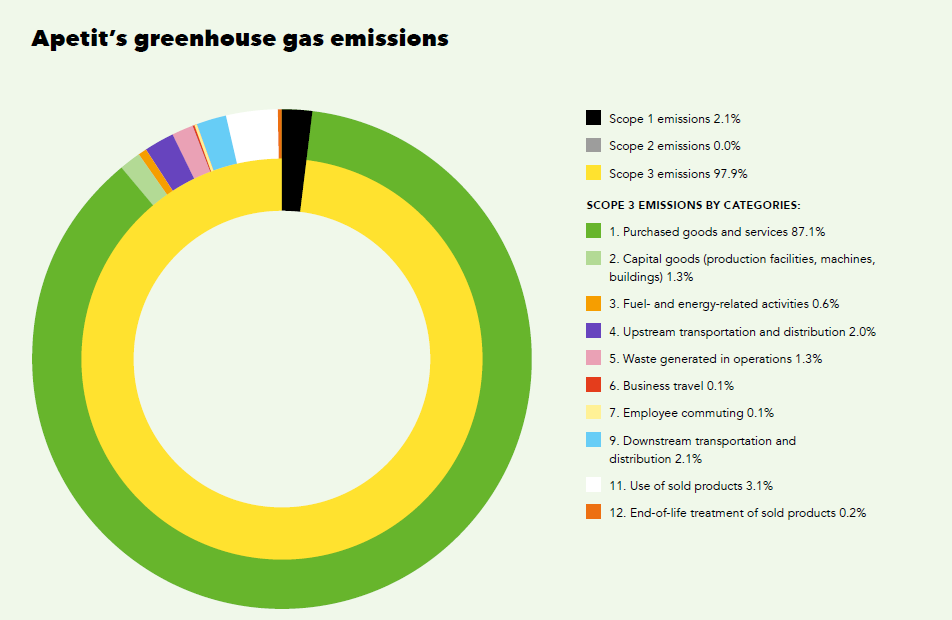
In recent years, the most significant emission reduction measures in own operations were related to investments to increase use of renewable energy. CO2 emissions related to energy used by Apetit have decreased by 80 per cent since 2019. In 2025, Apetit committed to setting science-based emission reduction targets covering the entire value chain.
Climate: Impacts and risks defined for Apetit’s operations
Nature and water
Biodiversity and ecosystem services are a key prerequisite for Apetit’s operations. Food production strongly depends on ecosystem services, such as soil condition, water availability, pollinators and nature’s ability to maintain nutrient circulation. The dependencies that are key to Apetit’s operations are related to farming in particular. Farming and primary production are the foundation of our food system, and at the same time they have impacts on nature that are material to Apetit’s sustainability work. In Apetit’s value chain, farming and raw material production are the most significant factors affecting biodiversity.
In its operating policy, Apetit is committed to reducing its environmental and climate impacts and promoting the sustainable use of natural resources. The development of cultivation methods and plant variety trials also play a significant impact on the management of risks caused by climate change. All of Apetit’s contract growers in Finland are covered by FSA (Farm Sustainable Assessment) certification. Contract growers in Sweden are IP Sigill -certified.
Apetit’s goal is also to promote the cultivation of Finnish rapeseed. The benefits of oilseed plant cultivation include, among other things, the increasing versatility of crop rotation, oilseed plants’ role as good preceding rotation crops and the increase of wintertime vegetation cover with winter oilseed plants. Apetit participates in RypsiRapsi-forum, which was established in 2023 and aims to bring together operators in the sector, increase the rapeseed harvest level and cultivation area and coordinate research and development in the sector.
Apetit also cooperates in various primary production R&D projects with parties such as Pyhäjärvi institute.In 2025, Apetit launched a pilot project with the Pyhäjärvi Institute with the aim of creating a farm-specific water protection survey and action plan.
Nature: Impacts and risks defined for Apetit’s operations